

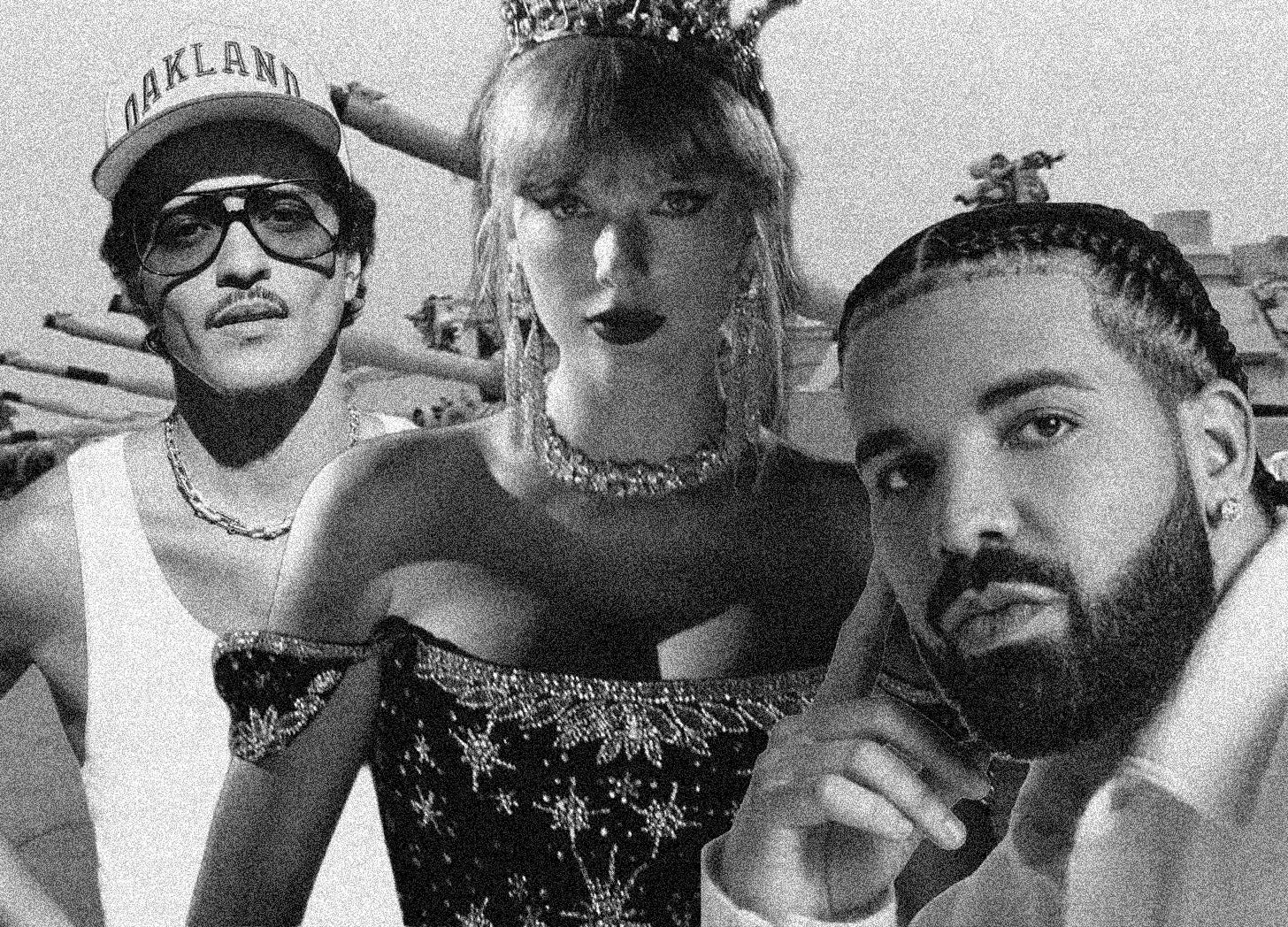
Bruno Mars had his first #1 hit as a solo artist in 2009, his most recent in 2026. He has never taken a break longer than one year from having a song in the Billboard Hot 100’s top 10. Those numbers suggest Bruno Mars is a game changing pop star, a Michael Jackson level talent. Instead, Bruno Mars is just… fine. His songs never surprise, they’re all dependable doses of nostalgia, wedding DJ fodder, perfectly safe. Never has he released anything communicating with boundary pushing, modern pop trends, instead choosing to consistently rehash 70s/80s/90s disco, funk, pop and R&B styles. But for 17 years and counting, Bruno Mars has been able to casually lob singles into Billboard’s penthouse whenever he wants.
This makes no sense. Imagine Billy Ocean, 17 years removed from “Caribbean Queen (Love on the Run),” boxing it out with Linkin Park and Alicia Keys for pop supremacy in 2001. Yet, somehow, a generation of millennial pop stars simply refuse to give up their stranglehold on pop music. When Neil Tennant coined the term ‘imperial phase’ in 1988, he was referring to a stretch of time that went on for maybe two years in which his band, the Pet Shop Boys, were putting up global hit singles. When Mariah Carey, almost inarguably the most dominant pop star of the 90s, ended her run on top with 2008’s “Touch My Body” she had logged a staggering 18 years of dominance. Taylor Swift has spent roughly as long at the peak of pop stardom but more concerningly is that Swift’s run feels like it’s going to go on forever. The album that produced Carey’s final number one, E=MC², didn’t have another competitor on it and you could feel her grip starting to loosen on the zeitgeist. Swift has had two number ones this year. Since 2022 she has yet to have a single miss the top 5. “Cruel Summer,” which reached the number one spot in 2023, is a song from her album Lover, an album that came out in 2019. In 2021 she re-recorded a deep cut from 2011, extending it from 5 to 10 minutes in the process, and that went to number one too. At all times we are in danger of any song Taylor Swift has ever released or will ever release becoming the most popular song on earth. This isn’t an imperial phase, it’s an imperial regime.
Rap music has taken its share of criticism for historically being a genre hostile to anyone over the age of 30, lest we forget Cam’ron sounding utterly disgusted at Jay-Z having the gall to both be both 38 years old and rocking sandals with jeans (he had to turn the beat off!) on 2006’s “You Gotta Love It,” but this emphasis on young talent made rap and hip-hop into a breathlessly exciting genre. A perpetual rock polisher of new talent rising and falling, artists innovating as fast as they could before aging out of the game. Aubrey Drake Graham; a man who was, I have to turn the beat off for this, born in 1986; had his first top 5 hit in 2009 and his most recent in 2026. That’s another 17 year reign on top, a reign that couldn’t even be stopped by the most withering series of diss tracks in rap history by yet another millennial artist that is even bigger now than he was when he debuted over 15 years ago. Before Drake, longevity in both a pop and a rap sense was maybe defined by LL Cool J1, who had his first top 10 in 1990 and his last in 2006. That’s 16 years and he was never as big as Drake is. And while I’m not going to sit here and pretend “Luv U Better” or “Control Myself” are classic bangers, LL still had to work to stay on top. Drake can casually toss anything he wants out there and count on it being a hit. On his most recent smash, “Shabang,” he sounds downright bored to be king for this long (“Don’t even recognize none of thеse names at the top of thе charts, I looked / Am I upset? A bit” he shrugs). As such, rap has become something shocking; it has become classic rock2. Even its younger icons - artists like 21 Savage, Lil Uzi Vert, Lil Yachty - debuted over a decade ago and have since resorted to screaming matches with the younger talent they were supposed to nurture but instead suppressed in order to make waves.
Bruno Mars, Taylor Swift and Drake are the three horsemen of pop music stagnancy. Even Lady Gaga - an artist who could be responsible for the last real deal, hands down, game changing imperial phase in pop music3 - had to call up (who else) Bruno Mars to get back on top for 2024’s predictably blah “Die With A Smile.” Not only is this quite the compromise for an artist as essential to the idea of forward thinking pop music as Lady Gaga, it was the power of her initial run that required author Tom Ewing to return the idea of an imperial phase to popular consciousness in order to describe it. In his 2010 ‘Poptimist’ article for Pitchfork, Ewing defines an imperial phase as a sense of command (“‘having the secret’ of pop”) permission (“a level of public interest, excitement and goodwill towards your work”) and a defining, tone-setting act that sets up the rest of your career. The ‘imperial regime’ inverts all three. You’re pop strictly in the sense of ‘popular,’ the music itself holds no surprises, the public is exhausted by your reign but powerless to do anything about it and rather than setting up the rest of your career you’re just repeating the sounds that made your career to begin with. For Swift this is the acoustic confessionals she originally perfected on 2008’s Fearless with the crossover-pop maximalism of 2014’s 1989, for Drake it’s the rude-boi roadman ‘tings he came up with for 2015’s If You’re Reading This It’s Too Late and for Bruno Mars it’s simply 1970 - 1996’s safest, most acceptable sounds.
Beyonce is both a member of this imperial regime and an outlier. Her run of number ones extends from 2003 (“Crazy in Love”) to 2024 (“Texas Hold ‘Em”), a staggering 21 years that doesn’t even account for Destiny’s Child. Yet, Beyonce continues to work as if her success is not guaranteed. Her game changing surprise drop record, 2013’s Beyonce, had only one top 10 hit on it and that top 10 hit (“Drunk in Love”) actually fell from #12 to #17 before climbing back to peak at #2. Lemonade had one top 10 (“Formation”) with the rest peaking anywhere from 11 to 38. When she made it back to the penthouse with the Ed Sheeran4 collaboration “Perfect” from 2017 it was a disappointing concession and felt like we might be entering into Beyonce’s own dusty imperial regime so that queen could stay queen. Instead, 2022’s Renaissance5 completely flipped the script with hardcore 90’s diva house styles. “Break My Soul”’s number one status was not assured, it debuted on July 2nd and didn’t peak until August 13th, and when it did make it there it was cause for celebration. It was a song you actually wanted to hear everywhere6, not one you were condemned with.
So what gives? How come the likes of Bruno Mars and Drake hit number one without a sweat but Beyonce still has to work for it. You could point to some combination of misogyny/racism and run those Twitter numbers up doing it but I think this is both not entirely accurate and insulting to Beyonce’s ability. Instead, as the oldest member of the imperial regime, Beyonce remembers a time before she was Queen Bee and continues to move accordingly. Consider that 2011’s 4 had a sum total of zero top 10 hits. When she reclaimed pop music as her shit, it was with a song that took shots at Keri Hilson of all people. Beyonce treats pop stardom as an arena you battle in, not a kingdom that you rule. You would never, will never, catch Beyonce farting out a song like “Shabang.” If her imperial regime continues you better believe it’s because she’s grinding for it. This puts Beyonce in league with artists like Madonna (1984’s “Like a Virgin” to 2001’s “Music”) and Janet Jackson (1986’s “When I Think of You” to 2001’s “All for You”), artists who fought and died for their time at number one. She’s a relic of a previous… why deny it, a better era of pop music in which you had to be good enough to convince your audience to get in their cars, drive to Circuit City and plunk down hard earned cash on your new album.
Taylor Swift’s 2025 album The Life of a Showgirl is almost universally considered to be her weakest record. Other than a disgraceful 5-star review from Rolling Stone7, who destroyed any sense of critical subjectivity by converting their entire website to a glorified fanpage in “celebration,” it received a series of middling scores and skeptical write ups from publications that had previously celebrated her every move. Even Pitchfork, a website that once adored Taylor Swift to such an extent they spent a day giving glowing re-reviews to her old albums just because, could only muster a dismal 5.9 out of 10, with Anna Gaca concluding her review by stating “if this is the only pop album you hear this year, maybe it’s good enough.” But on that same website the user-determined score is a scathing 3.8, with such comments as “This is an album that has almost no redeeming value, half-baked and barely eaten cake off the floor from her previous records.” To be on social media during this era wasn’t the critics vs fans showdown you may expect, fans by and large were disappointed. Oh, by the way, The Life of a Showgirl by Taylor Swift is the fastest selling album in music history. 2.7 million units on day one and 3.4 million first week. If you consult Wikipedia’s list of the fastest selling albums of all time, The Life of a Showgirl shatters the backboard on bona fide cultural sensations like Adele’s 25, Eminem’s The Marshall Mathers LP and *NSYNC’s No Strings Attached. Those three albums all have stories to tell about their success. Adele’s bucking of an EDM crazed pop market, Eminem’s voice of a generation status and unparalleled rap ability, NSYNC’s peak-boyband/peak-CD/peak-TRL mania. The poorly received Life of a Showgirl has no business being there yet it trumps them all8 because Taylor Swift scammed her fans. She released the album in a mind boggling 27 different formats, none of which contain anything essential but each is just different enough to compel die-hards to shell out for multiple copies of what is essentially the same album. Take a listen to one of those exclusive ‘voice memos’ and you tell me if that was worth the extra $13.99. There is no artistic justification for such a vast release strategy, this is pure greed. In a sense, The Life of a Showgirl does have a story to tell about its success, it’s just one that has nothing to do with music. In an America in which everything feels like or just plain is fraud, The Life of a Showgirl is the album we deserve. Taylor Swift isn’t just running the table on her fans but pop culture at large, remaining the alpha dog while putting out some of her worst music to date.
It’s a remarkable divergence for Taylor Swift because she simply is, without a doubt, one of our greatest living songwriters. Did you think the preceding paragraph meant I was going to try and tell you that “You Belong With Me” or “Fearless” or “Blank Space” aren’t straight up and down bulletproof classics? Not happening. But it took the relative flops of 2017’s Reputation, an album that nevertheless produced a number one hit, and, if not Lover as a whole, the apocalyptically abysmal, Brendon Urie featuring “ME!” to prompt the relentlessly self aware Taylor Swift to course correct with 2020’s stunning Folklore. This is someone who used to watch episodes of Behind the Music and take notes on what not to do in order to remain a pop star, after all. Will the chilly response to The Life of a Showgirl prompt a similar pivot? I don’t know, it’s literally the fastest selling album in music history with two number ones and a top five under its belt. How do you even begin to consider that a flop? She should be a Beyonce level talent, someone who continues to innovate simply because it’s her responsibility to do so. Instead she has settled into her imperial regime by chunking out Taylor Swift key-fabe and repositioning herself as a master of marketing foremost, songwriting second.
The blame for this cultural stagnation is simple and direct: Spotify. Before Spotify, and streaming music at large, an artist’s new single9 was a reset. You had to come up with something compelling enough to convince a subset of the population to once again shell out $10 - $20 on your new music. When Madonna’s output in the 2000s started to sag creatively her commercial fortunes declined with it. Just because three million people bought a copy of Music did not mean three million people were going to show up for 2003’s American Life and it bombed accordingly. She had to bounce back by writing an all timer with 2007’s “Hung Up” and even then her reputation had been dinged hard enough that it stalled out at #710. But now, if you were dominant right before the streaming era dawned, an era in which you had to work to win big in pop, those efforts carried over into the streaming economy and bought you a massive unshakable fanbase that assured you’d be able to stay on top for life. Bruno Mars has 132 million monthly listeners on Spotify, Taylor Swift 100 million, Drake 95 million. That’s a combined 327 million people primed and ready to consume whatever those artists release next for no additional charge. The amount of investment you had to make in order to follow your favorite pop star around (even with the relative simplicity of iTunes you still had to pay more to get their latest release) has been reduced to tapping the screen with your thumb. As such, these artists have zero initiative to do anything that might upset that passive audience of consumers. If their music stays in their wheelhouse, they can guarantee Spotify’s various playlists will be saturated by their newest release, recommended automatically by the algorithm.
Music has become yet another casualty of the broader shift in global sociopolitical life which is the tilt away from labor and towards capital. The artists that have to work to earn their spot in pop music’s penthouse vs the ones that own the entire building. You may consider Charli XCX’s Brat era her imperial phase, it has all the hallmarks (game changing, instant classic album, inescapable bangers, ample public goodwill) until you consider it contains zero hit singles. The album’s highest charting American hit is “360” with a tragic peak of #41, just barely shut out of the top 40 rotation11. And what was number one that summer instead? Post Malone and Morgan Wallen’s “I Had Some Help,” two more millennials who both seem to have the ability to just score number one hits whenever they feel like it, quality of music be damned. Post Malone has nine diamond certified singles, that’s 10 million sales each, as if “Better Now” has the same level of cultural importance as Lorde’s “Royals.” And you wanna guess which artist holds the record for most certified digital single of all time? Come on, take a shot, ready? Bruno Mars with “Just the Way You Are.” 21x platinum. That’s a lot of weddings.
Speaking of weddings, the other destabilizing element of Spotify has been that the incorporation of its streaming data into the Billboard charts means every time a song gets played on its platform, in any context, it adds to the song’s charting position. If a lazy DJ fires up one of Spotify’s “Wedding” playlists or your local grocery store is streaming Spotify as background muzak for your trip to buy some paper towels, that gets counted towards those songs charting position and certification. This would be like Kenny G having the most popular song of 1987 because “Songbird” got a lot of spins in dentist waiting rooms. Without getting into the quality of the song itself, Ella Langley’s “Choosin’ Texas” is currently stuck in the #1 position (21 weeks and counting) because it is stuck in the #1 position. It’s #1 so Spotify recommends it to users all the time which keeps it #1. Thus, a song that would have ran the country charts and peaked around #36 on the Hot 100 15 years ago is now the biggest Billboard hit in history.
Do real people authentically love “Choosin’ Texas”? Yes, absolutely. Do they ‘21 weeks and counting’ love that song? I’m not sure. It is a hit single, I’m not claiming its success - or the success of Bruno Mars, Drake, Taylor Swift, etc - is some kind of psyop but it’s our post-crypto/current-Polymarket culture that necessitates the line must continue to go up. These artists, these songs, have to keep getting bigger and bigger to justify both their absurd personal net worths and Spotify’s $108 billion valuation while the actual quality of our pop culture continues to suffer as a result. Why would Spotify do anything to prevent Taylor Swift or Drake from dominating pop culture when that domination increases their bottom line? Spotify is a tech company first, they have a direct financial incentive to ensure what’s big only gets bigger.
Without being able to access the heights they’re capable of, young pop talent like underscores and Slayyyter have turned to a different kind of pop star as a model; the “cult classic but [they] still pop” kind currently personified by Charli XCX but pioneered by Robyn and Carly Rae Jepsen.12 All three artists have experienced varying levels of real success - three solo top 10s and one number one between them - but each had to figure out a different way to thrive once their imperial phases ended. For Robyn that meant willing herself out of has-been status once her teen pop moment came to a halt over a refusal to remove lyrics pertaining to an abortion the singer had in 1998 from her sophomore album My Truth. Instead of fading away, Robyn struck back hard with 2005’s self-titled release which was a bona fide pop success in Europe but failed to make waves on American charts. What it did have in the states was a shitload of blog love, most significantly from an absolutely dominant Pitchfork Media (a publication that you could argue had both its own imperial phase and is now an imperial regime) that exposed a lot of Decemberist and Arcade Fire loving indie kids to its pleasures (yes, I’m talking about me). With 2010’s “Dancing On My Own” however, Robyn graduated from pop curiosity to her own cult-imperial phase. While, once again, being a real deal hit single across Europe, in the states “Dancing On My Own” was like a 21 week long number one hit in the hearts of hipsters across America. Today, Robyn can easily pack clubs in any major media market stateside, an impressive feat for someone whose mainstream legacy begins and ends with two top 10 blips from the late 90s.
Carly Rae Jepsen, on the other hand, did not have a mainstream blip. She had “Call Me Maybe,” a global number one sensation that was received with hosannas from the critical establishment as an instant cannon level pop music classic. When her only other hit from that era was the excruciating “Good Time” with Owl City, the Amazon Prime ripoff of The Postal Service that god blessedly was the one hit wonder we all hoped he’d be, Jepsen looked like she was going down as a beloved but slight pop sensation. Instead, she smacked the same indie kids that loved Robyn upside the head with 2015’s Emotion, an album that wasn’t supposed to be a cult classic but became one anyway after it failed to produce a hit single. While her subsequent albums haven’t reached those same heights, Jepsen still has her passport stamped to a lifetime of success outside the pressures of mainstream competition.
Who would Robyn or Carly Rae Jepsen be if they had never been forced to scramble? If “Call Your Girlfriend” or “Cut to the Feeling” had been record setting smash hits? They wouldn’t be nearly as vital as they are now, two shining examples on how to communicate with pop music whilst being unable to compete within it. Taylor Swift or Drake never would have “fallen off” with or without Spotify but by this point in their careers, they’re supposed to be in something like a dignified statesman pose, one in which they rest on their discographies while occasionally releasing something new for the fans, maybe making a comeback after years off the pop culture radar, and reliably filling arenas for life (Bruno Mars, on the other hand, should be deep into his ‘cruise ship’ era by now). Instead, they’re the big bad bullies of the pop world, to such a degree that Drake is copping to moving his release dates in order to steer clear of Taylor Swift, two battleships in an ocean of rowboats. While it would be exciting for artists like Addison Rae or Kim Petras13 to be able to release their best work and get rewarded for it the way pop stars are supposed to be, maybe it’s better that they have to continue to duke it out in a smaller arena. Perhaps one day the Hot 100 will become a relic of the music industry the way the Grammy’s are, nice to be mentioned but not essential. Until then, you - yes, you - are better off declining the easy route. If popular pop music is wearing thin, turn your attention to the underground. Find the kids that are actively pushing the genre forward and reward them with your time and attention. I could conclude this essay with the usual ‘i’m fucked, you’re fucked, we’re all fucked’ endpoint that so so much of pop culture writing indulges in, the ‘feel bad content for nobody’ thinkpiece that serves only to depress and upset you, but I’m not going to do that. The idea that “music was better when I was young” is an eternal lie, every generation has their own contributions to the cultural canon as essential as the one that came before them, this time you’re just going to have to work a little to find it. If you do, I promise it will be worth it and, if enough of us do, we can eventually put pop music back where it belongs.
I’ve been thinking hard about this and can’t come up with another rapper that both fought to be apart of pop music for so long and succeeded in the process. Jay-Z had a long run of pop hits too but they were more intermittent and, in his prime, he never sounded like someone chasing after the pop charts more the pop charts came to him.
If I wanted to expand upon rap music’s own imperial regime I’d add Future and Travis Scott in there, two artists whose boundary pushing peaks are behind them and are now simply too big to fail. Travis Scott, in particular, is a straight up pop music menace, with an obnoxious slew of number one hits that basically ceased to exist the moment they left the top spot.
This has to be a failure of imagination on my part, there’s no way the last true pop music imperial phase was that long ago. The only other artist that comes to mind is Ariana Grande (2018 - 2024?) but since she too is a millennial pop star that can keep hitting that number one spot without much effort I can’t really commit to this opinion. That’s the essential part of an imperial phase, it ends.
Ed Sheeran absolutely should be a member of the millennial pop music regime but he, blessedly, knocked himself off with 2021’s = and is now the UK’s problem, not ours.
Can’t figure a way to include 2024’s Cowboy Carter in here but it is worth noting that instead of hitting us with another diva house album she pivoted to country-western and was once again rewarded for the effort critically and commercially.
I remember it coming on my gym’s radio and I actually took my headphones off so I could enjoy it, not something I ever do otherwise.
Rolling Stone’s relentless Taylor Swift ass kissing is so over the top they literally invented a new “Instant Classic” label so they could award it to 2022’s Midnights. Swift nabbed this designation two more times with 2023’s 1989 (Taylor’s Version) and 2024’s The Tortured Poets Department before it was retired that year.
This really isn’t even half the story. Of the 23 fastest selling albums since 1991 listed by Wikipedia, Swift claims seven spots. No other artist has more than two entries.
While I do consider Mariah Carey to be the most dominant pop star of the 1990s it’s worth looking through her singles discography on Wikipedia and noting how hard she had to work to achieve that. 2002’s Charmbracelet couldn’t get a song in the top 40, let alone to #1, and this failure is what prompted Carey to recalibrate for 2005’s comeback smash The Emancipation of Mimi. Without the failure of the former, the later does not happen. It’s mission critical our pop stars fall off at some point to either make room for new talent or to come up with something good enough to put them back on top again.
This isn’t to say #7 is a flop just that “Hung Up” is so good it should have been a #1.
The “Guess” remix with Billie Eilish did manage to peak at #12 in the US (and #1 in the UK, wow) but it arrived later on and I’d hardly call a top 20 single imperial.
Has any male pop star achieved this kind of cult pop status? Are there any male pop stars left in general? What about us guys? Anyone? Hello?
Kim Petras actually did have a real-deal moment of popular success but, naturally, she had to hitch her wagon to a millenial in order to get it.
It's such a bummer to me that Bruno Mars is as talented as he is but all he ever does is just copy old stuff. Like AI but before AI.
What an amazing piece. Hits so many things I've been trying to articulate. Especially with how inorganic public music is now